Answering the need for highly visible golf balls, these models pair bold red and yellow colorways with performance features designed for distance, spin, and greenside feel. The top picks are ideal for players who want easy tracking in flight and on the green, plus reliable control from a consistent cover and core. Best for mid-to-advanced players seeking tour-style spin or softer greenside feel, with color contrast aiding alignment and focus.
| Product | Color Pairing | Why It’s Notable |
|---|---|---|
| Srixon Q-Star Tour 6 Divide Golf Balls, Yellow/Red | Yellow/Red | DIVIDE visual spin cue; 360° seam; Biomass urethane cover; FastLayer core |
| Srixon Q-Star Tour Divide Golf Balls, Red/Yellow | Red/Yellow | FastLayer Core for speed and feel; distinct color divide helps alignment |
| Callaway Golf Supersoft Golf Balls (2023, Red) | Red | Soft feel with fast core; long distance with control |
| Callaway Golf Supersoft Golf Balls (2026, Red) | Red | HyperElastic SoftFast Core; softened greenside feel; enhanced control |
| Callaway Golf Supersoft Golf Balls (2026, Yellow) | Yellow | Soft feel with fast speed; new cover system for greenside control |
Srixon Q-Star Tour 6 Divide Yellow/Red

The Srixon Q-Star Tour 6 Divide uses a 50/50 visual performance design. Its divide coloring provides a spinning strobe effect that helps players gauge wedge spin and face angle during practice and play. The 50/50 urethane cover blends tour-level greenside spin with durability, while the Biomass material lowers environmental impact. The FastLayer Core creates a blend of speed and a softer feel on irons and wedges. Best for players who want precise spin visibility and a softer, controllable feel around greens.
Who it’s best for: mid-to-advanced players who value spin visibility for practice feedback and a softer feel on short-game shots. Caution: some players may prefer a firmer feel with high-loft wedges.
Srixon Q-Star Tour Divide Golf Balls, Red/Yellow

The Q-Star Tour Divide uses the FastLayer Core to transition gradually from a soft inner core to a firmer outer edge, aiming to boost ball speed and distance while maintaining feel. The 50/50 matte urethane cover, with one half in a bright yellow and the other in red, aids alignment and spin visibility on approach shots. It’s designed for players who want a balance of distance and greenside control, with a bold color split for quick visual tracking. Best for players seeking reliable distance paired with high-contrast visibility.
Who it’s best for: players who want strong speed with a softer feel on mid-to-long irons and a highly visible ball at address and through flight. Limitation: the color split may be less appealing to players who prefer uniform ball visuals.
Callaway Supersoft Golf Balls (2023, Red)
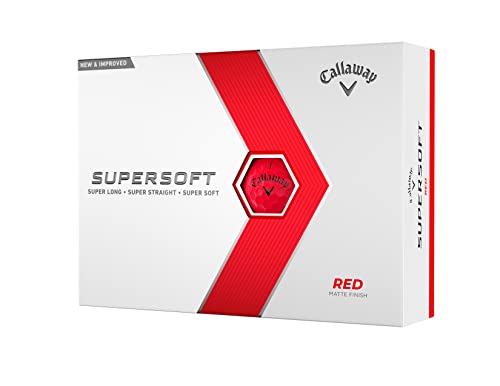
Callaway Supersoft 2023 uses the HyperElastic SoftFast Core to deliver increased ball speed with a soft feel. The hybrid cover is designed to provide greenside spin and control while maintaining distance. Best for players who prioritize a soft touch around the greens and consistent performance across the bag. Caution: the red colorway is highly visible, but the core and cover are optimized for maximum soft feel rather than protoned spin generation on long irons.
Callaway Supersoft Golf Balls (2026, Red)

The 2026 Supersoft Red model features the HyperElastic SoftFast Core for faster driver and iron speed with a soft greenside feel. The new cover system aims to combine distance with durability and control on approach shots. Best for players who want maximum distance with a softer feel on all clubs, including wedges. Caution: some players may prefer a firmer texture on cold mornings or in windy conditions.
Callaway Supersoft Golf Balls (2026, Yellow)

The 2026 Supersoft Yellow model delivers increased ball speed with a soft feel thanks to the HyperElastic SoftFast Core, engineered for faster speed on drives and irons while keeping greenside feel. The Yellow colorway enhances visibility against greens and rough. Best for players seeking an all-around soft feel with reliable distance and improved greenside control. Limitation: performance differences between weather conditions can affect spin consistency.
Buying Guide: Red And Yellow Golf Balls
- Visibility and alignment: Red and yellow colorways help with ball tracking in flight and alignment at address. Consider color contrast on the cover for quick visual cues.
- Core and cover technology: A soft FastLayer or HyperElastic core improves feel and distance. A urethane cover enhances greenside spin, while a durable cover adds longevity.
- Spin vs. distance balance: Players who rely on wedges may prefer a cover and core combo that emphasizes greenside spin and control. Distance-focused balls may favor a layered core design for faster speeds.
- Weather and course conditions: Dimple patterns and cover materials influence trajectory, lift, and drag. Matte 50/50 covers improve visibility in bright sun or overcast days.
- Player level and swing speed: Beginners may prioritize soft feels and forgiveness, while advanced players may seek precise spin visibility and consistent flight.
- Durability and greenside performance: Consider whether the cover composition suits frequent approach shots and short-game control on firm or soft greens.
Frequently Asked Questions
- Why choose red and yellow golf balls? They offer high visibility and contrast against fairways and greens, aiding tracking and alignment.
- Do red/yellow balls spin differently? Spin is more determined by core and cover construction; color mainly impacts visibility and alignment cues.
- Are 50/50 color splits durable? The color split is a design feature for visibility and does not typically affect durability when paired with a quality urethane cover.
- Is Supersoft suitable for all players? It’s designed for soft feel and distance, suitable for many players, but some may prefer a firmer feel around the greens.
- Which ball is best for wedge spin? Balls with urethane covers and softer cores generally offer greater greenside spin and control.
- How important is color for practice? Color can help with line and cadence in practice, and may reduce misreads on mis-hits when tracking velocity.