For dedicated golfers seeking portable data on swing speed, ball speed, and distance, personal launch monitors offer a practical, affordable way to improve performance. This guide highlights five reliable options, detailing who they’re best for, key strengths, and potential limitations. Perfect for practice at home, on the driving range, or during travel, these monitors help you track progress and tailor training plans.
Overview Of Top Picks
The following table provides a quick comparison of the five chosen products. It highlights the core metrics each device tracks, typical use cases, and the practical benefits for different types of players.
| Product | Best For | Key Metrics |
|---|---|---|
| PRGR HS 130-A Portable Golf Launch Monitor | Budget-conscious players who want Doppler radar data and no app dependency | Club head speed, ball speed, smash factor, total & carry distance |
| Shot Scope LM1 Portable Mini Launch Monitor | Players seeking real-time smash factor and distance data | Ball & club speed, smash factor, total & carry distance |
| Garmin Approach R10 | Indoor or home practice with comprehensive app support | Club head speed, ball speed, launch angle, shot dispersion |
| Voice Caddie Portable Golf Launch Monitor (SC200Plus) | Home and outdoor practice with real-time feedback | Swing speed, Doppler radar data, real-time voice feedback |
| Shot Scope LM1 PlayBetter Bundle | Players wanting subscription-free data with portable power | Club speed, ball speed, smash factor, carry & total distance |
PRGR HS 130-A Portable Golf Launch Monitor

The PRGR HS 130-A uses Doppler radar to track club head speed, ball speed, smash factor, and both total and carry distance. This model is best for players who want robust data without needing a smartphone app or wireless connectivity. It runs on AAA batteries and provides a memory of up to 500 swings, making it suitable for repeat practice sessions. A potential limitation is the lack of Wi-Fi or app-based features, which may matter to players who prefer cloud storage and deeper analytics.
- Best for budget-minded golfers who want straightforward, accurate swing data.
- Better for practice setups without a phone or internet connection.
- Limit: No built-in app ecosystem or wireless syncing.
Shot Scope LM1 Portable Mini Launch Monitor
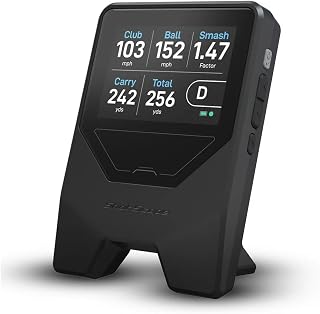
The LM1 delivers real-time ball and club speed, smash factor, and distance measurements. It is well suited for players who want compact hardware with dependable Doppler radar data and direct readings for on-the-spot feedback. The main strength is its emphasis on speed data and distance, which helps in refining tempo and yardage. A potential drawback is that it may require calibration for optimal accuracy in varying practice environments.
- Best for players prioritizing real-time speed and immediate distance feedback.
- Better for on-the-go practice with a compact form factor.
- Limit: Calibration and setup can affect precision in fluctuating environments.
Garmin Approach R10, Portable Golf Launch Monitor

The Garmin Approach R10 emphasizes a broad training environment, including indoor use and range sessions, with extensive data captured via the Garmin Golf app. It offers club head speed, ball speed, launch angle, and dispersion charts, helping players identify strengths and improvement areas. It pairs with a compatible smartphone and provides training modes and per-club stats. Best for players who want an integrated app experience with structured practice scenarios. Limitation: Some users may prefer standalone devices over app-driven analytics.
- Best for players investing in a full app-integrated training workflow.
- Better for indoor practice and long-term data tracking.
- Limit: Requires a compatible smartphone and app usage for full features.
Voice Caddie Portable Golf Launch Monitor SC200Plus

Voice Caddie SC200Plus focuses on Doppler radar data with real-time feedback via an LCD display and voice output. This makes it practical for training sessions where players prefer audible cues or do not want to constantly monitor a screen. It supports indoor and outdoor use and is designed to help users improve swing speed and tempo. The key caveat is that voice prompts may be distracting for some players in quiet practice spaces.
- Best for players who want real-time voice feedback during practice.
- Better for indoor training in living rooms or studios.
- Limit: Audible output may not suit all training environments.
Shot Scope LM1 PlayBetter Bundle

The PlayBetter Bundle combines the LM1 hardware with a 5,000 mAh portable charger and an extended feature set that emphasizes offline session history and club-based analytics. Best for players who want a reliable, subscription-free data experience with robust power support for longer practice sessions. The advantage is consistent data without ongoing fees, but users should ensure the bundled accessories meet their travel and charging needs.
- Best for travelers and long practice days with extended battery life.
- Better for players avoiding monthly subscription fees.
- Limit: Bundle accessories may be extra for some setups.
Buying Guide: Key Considerations For Personal Launch Monitors
What metrics matter most?
Answer depends on your goals. If you want overall swing data, prioritize club speed and ball speed. If you’re focusing on dispersion and consistency, launch angle and shot dispersion charts are valuable. For indoor practice without a phone, consider monitors with strong standalone capabilities or clear audio feedback.
App integration vs. standalone devices
Some models rely heavily on mobile apps to unlock features and store data, while others work offline. Decide whether you want cloud storage, cloud-based insights, or a simple, device-based readout. App-heavy systems can offer richer analytics but require a compatible device and ongoing connectivity.
Power source and portability
Battery life and battery type affect how long you can practice away from power sources. A few models use disposable batteries, others recharge via USB-C. If you travel frequently, a longer battery life and compact design are advantageous.
Environment suitability
Consider where you practice most—indoors, outdoors, or both. Some devices are optimized for indoor use with controlled radar measurements, while others accommodate wind and weather variability better. If you practice indoors, a model with stable measurements and easy calibration is preferable.
Data usability and longevity
Look for models that offer useful data export or clear in-device readouts. Longevity of data—saved swings and per-club statistics—helps track progress over weeks and months. Some devices keep a swing history, others push data mainly to an app.
Frequently Asked Questions
- Do personal launch monitors require a smartphone?
Not always. Some models function as standalone devices, while others rely on companion apps for full analytics and storage. - Which monitor is best for beginners?
Monitors with simple readouts and clear feedback, such as those offering real-time speed and distance, tend to be easier for beginners to use effectively. - Can I use these monitors indoors?
Yes, many models are designed for indoor practice and provide measurements that help you train even without outdoor swings. - Is Doppler radar necessary for accuracy?
Doppler radar is common and accurate for speed and distance data. Some devices use alternative sensors, but the Doppler-based units are typically easier to interpret and more consistent. - Do these devices require a subscription?
Some models offer free lifetime app access or no subscription; others may provide optional paid features. Always verify current terms at purchase. - How important is battery life?
Longer battery life supports longer practice sessions and reduces interruptions, especially for travel or outdoor use.