Get precise swing speed data to improve distance and consistency. This guide highlights top golf swing speed analyzers that work with or without balls, using Doppler radar or similar tech. Ideal buyers include: golfers who want ball-free practice data, club-head speed training enthusiasts, indoor trainers, and performance-minded players seeking portable solutions. Below is a quick buying table, followed by detailed product sections and a practical buying guide.
| Product | Best For | Key Benefit |
|---|---|---|
| PRGR HS 130-A | Budget-conscious players | Accurate data without apps or Wi‑Fi |
| RYP Golf Radar (RypRadar) | No-ball swing training | Non-contact swing speed measurement |
| Voice Caddie SC300i | Real-time data with long battery life | |
| TheStack Radar | Seamless data transfer to Stack app | |
| Swinora Golf Launch Monitor | 3D driving range and trajectory visuals |
PRGR HS 130-A Portable Golf Launch Monitor

The PRGR HS 130-A delivers club head speed, ball speed, smash factor, total and carry distance using advanced Doppler radar. Best for budget-minded players seeking accurate swing data without a smartphone or app. It does not require Wi‑Fi or Bluetooth and runs on AAA batteries, making it ideal for outdoor practice and travel. The device stores up to 500 swings for later review, aiding long-term progress.
Best for players who want a simple, affordable stand-alone monitor with reliable metrics. A potential limitation is that data is primarily numerical and may lack the richer app-based analytics found in higher-end units.
RYP Golf Radar Swing Speed Monitor (RypRadar)

RYP Golf Radar focuses on non-contact swing speed by measuring your swing with a Rypstick, Driver, or Iron. It’s best for players who want to train without striking a ball and still capture meaningful swing data. The unit’s non-ball design makes it convenient for quick sessions on a range, indoors, or in a small space.
Best for players who swing with or without a ball and want a simple, ball-free measurement. A limitation is that data scope may be narrower than full launch monitors that measure ball flight and spin.
Voice Caddie SC300i Portable Golf Launch Monitor

The SC300i provides measurements for swing speed, ball speed, carry and total distance, smash factor, launch angle, apex, and spin numbers via the My Swing Caddie app. It uses Doppler radar for reliable data and offers real-time analysis in indoor and outdoor settings. Battery life extends up to 20 hours, supporting long practice sessions.
Best for players who want a feature-rich system with real-time feedback and app integration. A limitation is that some advanced metrics require the accompanying app, which may involve a learning curve for new users.
TheStack Radar | Golf Launch Monitor
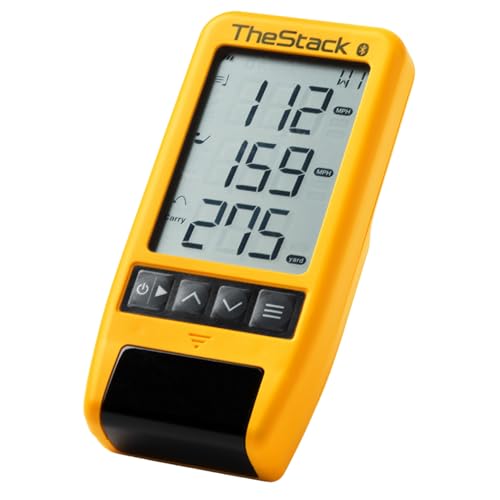
TheStack Radar measures swing speed and ball speed, with an estimated carry distance and smash factor. It integrates with TheStack app for Bluetooth-based speed training and wedge practice, including a 1-month free trial of Stack Wedge Mode on iOS. This is a solid choice for those who prefer app-connected workouts and gamified practice sessions.
Best for app-based training and integrated wedge practice. A caveat is that full benefits rely on using TheStack ecosystem, which may require ongoing app engagement.
Swinora Golf Launch Monitor & Simulator

Swinora offers a portable swing analyzer with 13 metrics, a 3D driving range, and 3D trajectory visuals, designed for iOS/Android. It includes environmental sensors that adjust data for real-time conditions, making it useful for indoor and outdoor practice. A key benefit is the immersive 3D simulation with smart alerts to guide practice sessions.
Best for players needing extensive metrics and engaging visualization. A potential limitation is that the monitoring experience greatly depends on the accompanying app’s features and space requirements for accurate radar capture.
Buying Guide: Key Purchase Considerations
- Budget vs. data depth: Basic models deliver essential swing speed data; premium options add ball speed, path, spin, launch angle, and app-based analytics. Decide how deeply you want to track performance.
- Ball presence: If you train without hitting balls, consider non-contact options like RYP Radar or similar devices. For full flight data, choose models that measure ball speed and trajectory.
- Portability and power: Battery life, weight, and size affect travel and on-site practice. Devices running on AAAs or built-in rechargeables offer different conveniences.
- App integration: Some systems pair with dedicated apps for deeper analysis, drills, and sharing results. Ensure compatibility with your smartphone and preferred platform.
- Space and environment: Indoor use often requires careful space planning and radar placement. Check space recommendations for optimal data capture.
- Data stability and accuracy: Look for devices with Doppler radar or proven non-ball measurement methods, and note stated accuracy ranges to set realistic expectations.
- Data history and memory: Values like 500-swing memory or cloud storage can help track progress over time. Consider how you’ll access and compare past results.
Frequently Asked Questions
- What’s the main difference between ball-tracking launch monitors and non-ball swing analyzers?
Answer: Ball-tracking monitors measure ball flight (speed, distance, spin), while non-ball analyzers focus on swing metrics like club-head speed and tempo. - Can I use these devices indoors without a special setup?
Answer: Yes, many models are designed for indoor use with space guidelines; some require a clear line of sight and a minimal room length for accurate data capture. - Do these monitors require a smartphone or app?
Answer: Several models rely on companion apps for expanded analytics, though some offer standalone data readouts without apps. - Is non-ball training less accurate than ball-based systems?
Answer: Non-ball training provides solid swing data (speed, tempo) but won’t capture exact ball flight; ball-based systems deliver flight metrics like carry and apex. - How important is battery life for practice sessions?
Answer: Longer battery life supports extended practice sessions, especially for indoor or outdoor rounds where charging isn’t convenient. - Which product is best for app-driven training?
Answer: TheStack Radar pairs with TheStack app for integrated speed training and gamified wedges, offering a cohesive practice ecosystem.