Finding the right golf launch monitor depends on your budget, environment, and data needs. This guide highlights five reliable options, from portable trackers to home-friendly systems, to help you improve distance, accuracy, and consistency. The picks are best for varying players: beginners seeking basic feedback, enthusiasts chasing precise ball and club speeds, and indoor players needing battery longevity and offline use.
Summary of selected products:
| Product | Best For | Key Data |
|---|---|---|
| Shot Scope LM1 Portable Mini Launch Monitor | On-the-go data and real-time metrics | Ball/club speed, smash factor, total & carry distance |
| Rapsodo MLM | Indoor/outdoor practice with video trace | Ball speed, club speed, launch angle, carry, shot tracer |
| Garmin Approach R10 | Home practice with long battery life | Club head speed, ball speed, launch data, shot dispersion |
| Voice Caddie SC300 | Home or outdoor swing analysis | Swing speed, ball speed, carry, apex, spin |
| PRGR HS 130-A | Budget-friendly launch data | Club speed, ball speed, smash factor, carry |
Shot Scope LM1 Portable Mini Launch Monitor
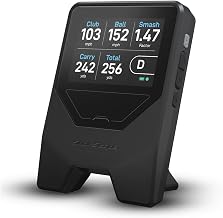
Features include advanced ball and club speed tracking, real-time smash factor, and instant measurements of total and carry distance. This compact unit is designed for players who want quick, actionable feedback on range or practice nets. Best for golfers who travel often or have limited space and still need precise, actionable numbers.
Who it’s best for: players who value portability and instant, on-device speed and distance data without relying heavily on a smartphone app. Limitations: some users may prefer devices with broader data sets or more expansive swing analysis features.
Rapsodo Mobile Launch Monitor Golf Simulator

Rapsodo MLM provides shot-by-shot feedback for range, backyard, or indoor nets, with ball speed, club speed, launch angle, carry distance, and shot shape data. It includes video replay with shot tracer to visualize flight and identify swing faults in real time. This makes it ideal for beginners and intermediate players who learn visually from data and motion.
Who it’s best for: players who want integrated video analysis and a clear view of how tweaks affect ball flight. Limitation: may require setup for best results in tight spaces or with certain camera angles.
Garmin Approach R10

Garmin’s R10 is built for home practice and range use with up to 10 hours of battery life. Data includes club head speed, ball speed, launch angle, and dispersion charts when paired with the Garmin Golf app. It’s a strong option for players who want detailed metrics and long-term tracking in a portable form factor.
Who it’s best for: players who want robust analytics and a structured training plan via Garmin’s app ecosystem. Caution: waterproofing is limited to standard ratings, so use in varied weather with care.
Voice Caddie Portable Launch Monitor

Voice Caddie SC300 uses Doppler radar to measure swing speed, ball speed, carry/total distance, smash factor, launch angle, apex, and spin (spin data available in the My Swing Caddie App). The device emphasizes reliable data collection for home or outdoor use with up to 20 hours of battery life.
Who it’s best for: players who want long battery life and a comprehensive parameter set, including spin measurements. Caution: spin data availability may depend on app integration and specific modes.
PRGR HS 130-A Portable Golf Launch Monitor

The PRGR HS 130-A offers accurate data on club head speed, ball speed, smash factor, and total & carry distance using advanced Doppler radar. It is pitched as a more affordable option that does not require Wi-Fi or apps and can store up to 500 past swings.
Who it’s best for: budget-conscious buyers who still want meaningful swing metrics and offline operation. Limitation: some advanced features found on higher-end models may be absent, and data interpretation may rely on simpler interfaces.
Buying Guide: Key Considerations For Selecting A Launch Monitor
Why choose a launch monitor? It helps quantify swing and ball data to guide practice, refine distance control, and build repeatable swing patterns. Consider these factors when evaluating options:
- Data metrics: Ensure the device reports essential metrics for your goals (ball speed, club speed, launch angle, carry, smash factor). Some models add spin, apex, or trajectory visuals.
- Portability and setup: Portable units suit travel and small spaces. Some require a phone app or camera alignment; others function standalone with memory storage.
- Indoor vs outdoor use: If you train indoors, ensure the device handles low-light or net setups and offers reliable data at close distances.
- Battery life: Longer battery life benefits outdoor practice and extended sessions, particularly if you practice away from power.
- Software ecosystem: Apps can offer drills, stats tracking, and training plans. Consider whether you prefer Garmin, Voice Caddie, or other ecosystems for long-term training.
Practical Tips For Getting The Most From Your Monitor
- Calibrate lightly and follow the manufacturer’s setup recommendations to minimize data drift.
- Use consistent practice conditions (hitting net vs. fairway) when comparing data across sessions.
- Combine numeric data with visualization (where available) to better interpret flight and swing changes.
Frequently Asked Questions
- Do these devices require a smartphone? Some models use a companion app, while others operate standalone or with optional apps. Check the product page for specifics.
- Can I use these launch monitors outdoors without a net? Many devices support range or field practice; verify recommended environments before use.
- What is the typical accuracy range for ball speed data? Most devices aim for within a few mph accuracy, though exact figures vary by model and mode.
- Is spin data available on all models? Spin data is available on select models and may require app access or specific modes.
- How important is battery life for practice sessions? For frequent outdoor practice or ranges, longer battery life reduces interruptions and increases session length.
- Can I track improvements over time with these monitors? Yes, most devices record sessions that can be exported or saved for future comparison.