Looking for the best golf ball flight tracker to improve accuracy, analyze your swing, and practice indoors or outdoors? This guide highlights top devices that capture shot data, club speed, launch angle, and ball flight. Whether you’re a serious hobbyist, a weekend golfer, or a coaching-focused player, these trackers fit different needs—from full simulators to compact on-course aids. The products below are chosen for reliability, data depth, and ease of use in real-world practice settings. A quick summary table follows to help you compare at a glance.
| Product | Best For | |
|---|---|---|
| Rapsodo MLM2PRO | All-around swing analysis and home driving range | Carry, ball speed, club speed, launch angle, spin, path |
| Arccos Smart Sensors | Full game tracking with AI caddie | Strokes gained, club distances, GPS rangefinder |
| Arccos Air | Sensor-free tracking with AI analytics | Shot tracking, AI strategy, strokes gained |
| Voice Caddie SC200Plus | Real-time feedback and swing speed practice | Swing speed, Doppler data, voice output |
| SC4 Pro | 3D driving range and indoor/outdoor use | Ball and club data, E6 Connect, driving range |
Rapsodo – Mobile Launch Monitor for Golf

The Rapsodo Mobile Launch Monitor offers GPS satellite view and real-time swing analysis. It measures ball speed, club speed, and launch angle for both indoor and outdoor use. This device is best for players who want tour-level data in a compact form and the ability to review video playback with active shot tracers. It is suitable for home practice setups and driving range sessions. A limitation is that some users may prefer more extensive simulated course options, which are enhanced with additional software.
Rapsodo MLM2PRO Launch Monitor

The MLM2PRO uses Doppler radar and a dual-camera setup to deliver 15 key metrics, including spin rate, spin axis, carry distance, and more. It includes a 45-day premium trial for simulated courses and app integrations. This model is best for players who want deeper data analytics and access to training features. It’s better for serious practice and players who value course simulation, though the initial setup is more involved than entry-level units.
Arccos Smart Sensors

The GEN 4 Arccos system includes 16 weather-resistant sensors for every club, plus a putter sensor. It pairs with the Arccos app for automatic tracking and metrics like strokes gained. It’s best for players who want a comprehensive, app-driven game-tracking experience with long-term strategy insights. A potential limitation is the requirement for an active membership after the first year for continued premium features.
Arccos Air – Automatic Golf Tracking
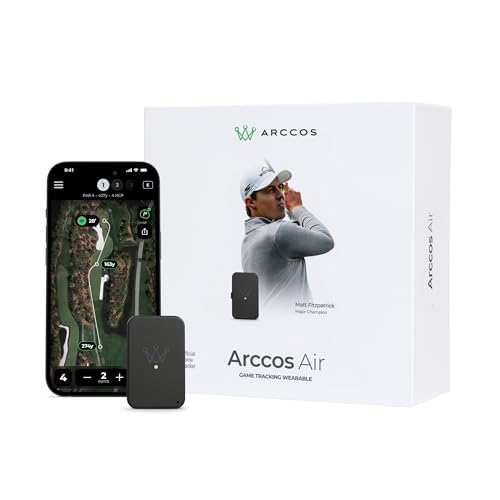
Arccos Air tracks shots automatically with GPS and AI, no sensors required. It weighs the ease of use—just wear the Air device and play—while delivering shot tracking and strokes gained analytics. This option is ideal for golfers who want a hands-off experience and affordable AI-driven insights. The primary caveat is that features are maximized with the first-year membership, and ongoing access requires renewal.
Voice Caddie SC200Plus

The SC200Plus emphasizes real-time feedback with Doppler radar and an informative LCD with voice output. It is best for players who want immediate coaching cues and a portable practice companion for speed work without heavy setup. A limitation is that some users may prefer more extensive course simulations or additional data depth beyond swing speed and ball flight metrics.
SC4 Pro Golf Launch Monitor

The SC4 Pro combines pro-grade accuracy with Prometrics Engine and access to 3D Driving Range and E6 Connect. It’s best for golfers who want a robust practice setup with immersive virtual experiences and no monthly subscription. It is especially appealing for home users seeking a capable indoor/outdoor system with strong data tracking. A caution is that a solid setup is needed to maximize 3D range features.
Buying Guide: Key Purchase Considerations
- Data depth vs. ease of use: Choose a system offering the metrics you need (carry, spin, launch angle, strokes gained) and balance with setup simplicity.
- Indoor vs. outdoor compatibility: Some trackers excel indoors with dense data, while others emphasize outdoor driving range simulations.
- Sensor approach: Sensor-based systems (multiple club sensors) provide club-level data, while sensor-free options rely on GPS or camera data and may be simpler to use.
- Software ecosystem: Look for apps that provide intuitive dashboards, drills, and integration with training aids or simulators.
- Subscription and membership: Some products require ongoing app memberships for premium features; consider long-term value.
- Portability and power: Battery life and weight matter for travel and on-site practice sessions.
FAQs
- What is the main difference between sensor-based and sensor-free golf launch monitors?
Sensor-based systems use sensors in the clubs or accessories to capture data; sensor-free systems rely on GPS, radar, or camera analysis for shot data. Sensor-based setups often provide deeper club-specific metrics, while sensor-free options tend to be simpler to use. - Do these trackers require a subscription to access data?
Some models include free access for a limited time or require ongoing membership for premium analytics and simulated courses. Check each product’s terms for the latest details. - Can I use these devices indoors without a full driving range?
Yes, several models are designed for indoor use and can connect to nearby screens or projectors to simulate practice environments. Some features may be limited indoors. - Which tracker is best for a beginner golfer?
Entry-level options with straightforward interfaces and essential metrics are ideal for beginners. Models like sensor-free Arccos Air or basic Rapsodo configurations can be suitable starting points. - Which tracker is best for long-term game improvement?
Systems offering comprehensive analytics, strokes gained, and AI strategy guidance—such as Arccos Smart Sensors or MLM2PRO with premium trials—are strong candidates for ongoing improvement. - Are these devices compatible with standard golf apps?
Most products provide companion apps or integration with popular golf ecosystems, enabling data export, practice drills, and course simulations.