Answering the question “which portable launch monitor fits my needs in 2022?” these picks focus on accuracy, battery life, price, and ease of use. They’re ideal for golfers who train at home, indoors, or on the range and want immediate feedback without complex setup. The top picks vary by buyer type: budget-conscious buyers, tech-enhanced enthusiasts, and those seeking high portability for indoor practice. Below is a quick summary table of the chosen products to help compare at a glance.
| Product | Main Benefit | |
|---|---|---|
| PRGR HS 130-A | Accurate data with Doppler radar; no app required | Budget-friendly practice without connectivity |
| Shot Scope LM1 | Real-time smash factor; robust data for all swings | Active training with detailed metrics |
| Garmin Approach R10 | Home and range versatility with long battery life | Home practice with app integration |
| Voice Caddie SC200Plus | Real-time feedback with voice output | Indoor and outdoor training with audible cues |
| Rapsodo MLM | Shot tracer video and comprehensive data | In-depth practice with video analysis |
PRGR HS 130-A Portable Golf Launch Monitor

The PRGR HS 130-A uses advanced Doppler radar to measure club head speed, ball speed, smash factor, total and carry distance. It operates without Wi-Fi or apps and can run on AAA batteries, making it simple and portable. This unit is known for delivering accurate swing data in a compact package, and it can store up to 500 swings for later review.
Best for: Budget-conscious golfers who want a straightforward, no-frills launch monitor with reliable data. This model suits home practice or practice on the driving range where connectivity is limited or unnecessary. A key limitation is the lack of wireless connectivity or companion app, which may restrict long-term trend tracking for some users.
Shot Scope LM1 Portable Mini Launch Monitor
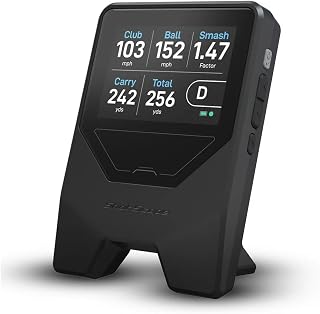
The LM1 provides advanced ball and club speed tracking with real-time smash factor and complete carry distance for every swing. Its compact design pairs with clear, instant metrics, making it a strong choice for players who train frequently and want immediate feedback without complicated setup.
Best for: Players who want a compact, all-in-one training tool with robust data and quick, actionable feedback. Choose this if you value real-time metrics and seek a device that travels well to the range or gym. A potential limitation is that, as with many mini monitors, the data interpretation benefits from consistent practice and a good swing routine to maximize insights.
Garmin Approach R10, Portable Golf Launch Monitor

The Garmin R10 is designed for indoor use and outdoor practice, with a long-lasting battery (up to 10 hours). It offers club head speed, ball speed, launch angle, and other metrics when paired with the Garmin Golf app. The device emphasizes app-based tracking and a training mode that tracks performance by club, including shot dispersion charts.
Best for: Golfers who prefer integration with a dedicated app and long battery life for extended practice sessions. Avoid this if you prefer standalone data or a simpler setup without a companion app; the full benefits come with ongoing app usage and data analysis.
Voice Caddie Portable Launch Monitor and Swing Analyzer (SC200Plus)

The SC200Plus uses Doppler radar with atmospheric sensors to provide reliable data and real-time feedback, including an LCD display and voice output. This model is designed for both indoor and outdoor training, helping you hear your performance cues as you practice.
Best for: Players who benefit from audible feedback during practice and want a hands-free way to track swing speed and tempo. A limitation to note is that some features may rely on specific calibration steps or setup within the app ecosystem, which could require a learning curve for new users.
Rapsodo MLM Golf Launch Monitor

The MLM provides ball speed, club speed, launch angle data, and carry distance, with the added feature of video replay and shot tracer to visualize ball flight. It emphasizes indoor and outdoor use and is compatible with iPhone and iPad, giving you a familiar tech experience while practicing.
Best for: Golfers who want integrated video analysis with numeric data, plus the ability to review swings frame-by-frame. Choose this if you value visual feedback to pinpoint swing faults. A potential limitation is that some users may require a compatible iOS device for full functionality and use of all features.
Buying Guide
What should you consider when choosing a portable launch monitor?
- Data metrics: Identify which metrics matter most to you (ball speed, club speed, launch angle, carry distance, smash factor). Some models emphasize video replay or voice feedback, while others focus on raw numbers.
- Connectivity and app use: Decide if you prefer a standalone device or one that integrates with a companion app for trend analysis and club-by-club breakdown.
- Portability and battery life: Consider whether you need battery-powered operation for field practice or longer sessions on the driving range.
- Indoor vs outdoor use: Some monitors are optimized for indoor use with compact form factors, while others offer ruggedness or better range outdoors.
- Ease of setup: If you want quick practice sessions, look for devices with simple calibration and minimal configuration steps.
- Video analysis options: If you value visualization, models with shot tracer or video replay can help identify swing faults more clearly.
Which monitor is best for specific needs?
- Best overall value for beginners: PRGR HS 130-A with straightforward operation and strong data.
- Best for detailed real-time metrics: Shot Scope LM1 for comprehensive swing data.
- Best for app-driven home practice: Garmin Approach R10 with extensive training modes and charts.
- Best for audible feedback: Voice Caddie SC200Plus with voice outputs during practice.
- Best for video-assisted practice: Rapsodo MLM combines data with shot tracing and video review.
What are common limitations to expect?
- Some models rely on apps or devices to access full features, which may introduce a learning curve.
- Standalone devices may have fewer long-term trend analytics compared with app-connected options.
- Data interpretation benefits from consistent practice; early users should set clear practice goals.
FAQs
- Do portable launch monitors work indoors? Yes, many models are designed for indoor practice, with some offering indoor/outdoor versatility.
- Is Doppler radar data reliable for swing speed? Yes, Doppler radar provides reliable speed measurements and is common across models listed.
- Can I use these without an internet connection? Some models operate offline, while others require app pairing for full features.
- Which monitor tracks carry distance the best? Models like PRGR and Rapsodo MLM emphasize carry distance data with consistent performance.
- Do I need a smartphone to use these monitors? Some models pair with dedicated apps; others function as standalone devices with built-in displays.
- Are these devices suitable for beginners or advanced players? They support both, but some are better for learners (budget options) while others suit data-driven practice (advanced users).