Buying a complete junior golf set for ages 12 to 14 means balancing swing speed, control, and height with the right weight. This guide helps buyers compare 12–14 full sets that support growth, accuracy, and confidence on the course. The top picks below are selected for mid‑teens who are transitioning from beginner clubs to more advanced gear. Each option notes who it’s best for, plus practical considerations like weight, shaft material, and bag features.
| Product | Best For | Why It Stands Out |
|---|---|---|
| PGA Tour Youth Golf Club Set – 10-Piece (12+) | Beginners and improving players ages 12-17 | Official PGA TOUR set with lightweight stand bag and improved alignment putter |
| 1GoTo-G 7 Pieces Kids Golf Set (12-14) | Compact 7‑piece starter for precise control | Ultra-lightweight, balanced for age 12-14 with driver, hybrid, irons, and putter |
| Tivor Youth 12-14 11-Piece Set | Older juniors aiming for transition to standard gear | 400cc driver and complete set in a lightweight bag |
| Precise Complete Teen Set (13-16) | Power and forgiveness for taller teens | Titanium driver and perimeter-weighted irons |
| Aspire XD1 Teen Set (13-16, Right) | Teens seeking pro-style configuration | Graphite woods with steel irons for speed, balance, and control |
PGA Tour Youth Golf Club Set – 10-Piece (12+)

This 10-piece set targets players aged 12 and up (5’2″ to 5’10”). The official PGA TOUR design supports both beginners and improving players, with a lightweight stand bag and a mallet putter featuring alignment aids. Best for junior players who want a full, professional-grade kit in one package. The flexibility of a driver, hybrid, and irons supports mid-teen swing development. A caution: the bag’s storage is generous, but heavier sets may be less ideal for younger beginners who still adapt to full-length clubs.
PGA Tour Youth Golf Club Set – 10-Piece (8-12)

Designed for ages 8-12, this set remains a relevant comparison for lighter, easier swings, though it’s slightly below the 12–14 range. For families with siblings in different age brackets, this can be a stepping-stone option before moving to the 12–14 set. It emphasizes forgiveness and weight reduction suitable for improving golfers adjusting to proper form.
PGA Tour Left-Handed 12-17 Set

Left-handed options mirror a right-handed lineup, with similar structure and features to the right-handed sets. Best for left-handed junior players who want a consistent set designed to support longer, more accurate shots as they grow. Note that some left-handed configurations vary by age tier and available stock.
Aspire XD1 Teen Set – Right Hand (13–16)

This teen-tailored kit balances weight and swing speed with 100% graphite shafts for woods and True Temper steel for irons. It includes a driver, fairway wood, hybrid, irons, putter, stand bag, and headcovers. Best for teens who want a pro-style kit that supports higher swing energy and distance while maintaining control. A caveat: graphite shafts can feel different if the player is used to steel shafts, requiring a short adaptation period.
Aspire XD1 Teen Set – Left Hand (13–16)
Left-handed version mirrors the right-handed configuration, offering teen players symmetry in choice. Best for left-handed teens seeking a complete kit with a balanced weight distribution. The combination of graphite woods and steel irons supports distance with precision, though adaptation to shaft feel may vary by player.
Precise Complete Teen Set (13–16)

Designed to bridge junior and adult club sizes, this kit emphasizes distance, forgiveness, and control. The titanium driver and perimeter-weighted irons contribute to longer carries with stable shots. Best for teens who need a robust set that remains usable as they approach taller growth, though it may be heavier than some 11‑piece junior sets.
Tivor 12-14 11-Piece Set
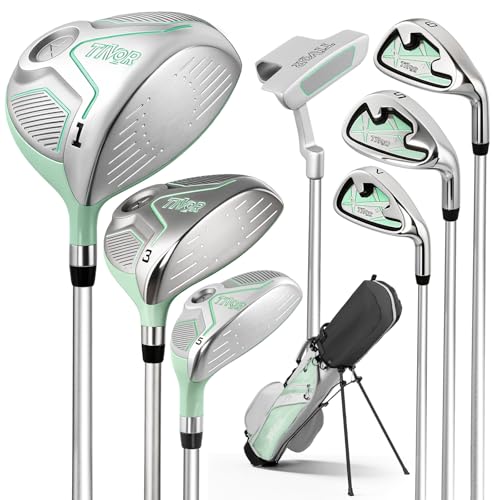
Tailored for tall juniors 12–14, Tivor’s 11-piece bundle offers an oversized driver and fairway wood, plus a full set of irons and a putter. Best for players ready to handle longer clubs with a larger clubface and forgiveness. A limitation: the set’s length specs may require a fitting check for players at the upper end of height range.
Buying Guide: Key Purchase Considerations
- Age, height, and swing speed: Choose sets that align with the teen’s current height (roughly 5’2″ to 5’8″) and speeding control for consistency.
- Club weight and shaft material: Graphite shafts are lighter and faster for juniors; steel shafts offer stability for some players but add weight.
- Number of clubs: A 7‑piece kit is compact and easy to handle; a 10‑piece or more provides more options but adds weight.
- Head design and forgiveness: Larger sweet spots and perimeter weighting help with mis-hits and longer carry.
- Bag and portability: A lightweight stand bag with good strap comfort improves on-course mobility for young golfers.
- Left-handed options: Ensure a right or left-handed configuration is available to match the player’s dominant hand.
- Future growth: Consider sets with slightly adjustable lengths or those designed to last through most of the teen growth phase.
Frequently Asked Questions
- What is the best age range for a 12–14 junior set?
– Sets labeled for ages 12–14 are typically sized for players within about 5’1″ to 5’7″, with swing speeds suitable for teens transitioning from beginner to intermediate play. - Should I choose graphite or steel shafts for a 12–14 player?
– Graphite shafts reduce weight and can help generate swing speed, while steel shafts offer stiffness and precision; graphite is usually preferred for younger teens. - Is a 7-piece set enough for a beginner in this age group?
– Yes, a 7-piece kit with driver, hybrid, irons, putter, and a bag is a practical starter; add more clubs later as needed. - Do left-handed junior sets differ significantly from right-handed ones?
– The main difference is the orientation of the clubs; performance and forgiveness usually remain similar across hands. - Can a teen grow out of a junior set quickly?
– Growth spurts vary; look for sets with form-fitting head sizes and a reasonable length range to extend usability.