Looking to improve swing mechanics with trusted training aids? This guide highlights five highly relevant products that align with the Ben Hogan golf fundamentals. Each selection targets different players—from beginners seeking proper grip to seasoned golfers refining tempo and on-plane movement. The top choices focus on grip, swing path, timing, and club control to support a more repeatable, powerful swing.
| Product | Best For | Why It Stands Out |
|---|---|---|
| Ben Hogan’s Five Lessons: The Modern Fundamentals of Golf (Definitive Edition) | All levels seeking core fundamentals | Classic guidance from the Hogan framework on grip, stance, swing plane, and alignment. |
| The Swing Factor Golf Trainer – Left Handed | Developing correct grip and on-plane swing | Visual and tactile feedback for a repeatable grip and swing path. |
| Power Golf | Anyone preferring classic Hogan reading on power | Foundational golf concepts from the Hogan authorship. |
| Golf Swing Trainer Rope | Tempo, rhythm, and warm-up | Flexible design that promotes smoother sequence and natural feedback. |
| Golf Swing Trainer (Auto Distance & Accuracy) | Immediate feedback on swing mechanics | Emphasizes fixing common swing wreckers and grip consistency. |
Ben Hogan’s Five Lessons: The Modern Fundamentals
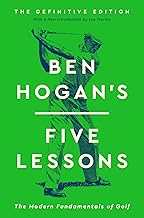
Best for: Beginners and mid-level players seeking a solid theoretical base. This definitive edition distills Hogan’s core ideas—grip, stance, posture, alignment, and the on-plane swing. It serves as a reference to guide practice sessions and drills aligned with the Modern Fundamentals.
Why chosen: The book’s structured lessons help players internalize a repeatable swing model, making it a strong anchor for any Hogan-inspired training plan.
Limitation: It is a book, not a physical trainer, so practical in-person drills should be paired with live feedback or a training aid for kinesthetic learning.
The Swing Factor Golf Trainer – Left Handed

Best for: Left-handed golfers or players seeking a clear guide to grip and plane awareness. The Swing Factor aids in ingraining a correct grip, wrist set, and on-plane movements through both visual and tactile cues.
Why chosen: Its emphasis on the “on-plane” swing and the pro slot technique makes it a practical complement to Hogan’s fundamentals, especially for players who want actionable feedback during practice.
Limitation: It focuses on specific swing mechanics, so users may need additional drills to address overall ball-striking consistency across varying clubs.
Power Golf

Best for: Players who want to reinforce Hogan’s power concept through readable guidance. This paperback offers accessible insights into power generation and swing mechanics aligned with classic fundamentals.
Why chosen: It provides a concise, practical framework to translate Hogan’s ideas into more forceful and efficient ball striking, suitable for mid-level players seeking measurable improvement.
Limitation: As a lightweight paperback, it may lack the interactive feedback of more hands-on aids.
Golf Swing Trainer Rope

Best for: Players who want tempo and rhythm coaching during warm-ups or on-course practice. The flexible rope provides clear movement feedback and encourages full body rotation.
Why chosen: Its natural responsiveness helps players feel how the arms and torso coordinate, aligning with Hogan’s ideas about connected swings and timing.
Limitation: The tool is tempo-focused and may require complementary drills for accuracy and distance control on full swings.
Golf Swing Trainer (Distance & Accuracy)

Best for: Golfers aiming for faster improvements in distance and precision while retaining proper grip and swing sequence. The device claims to help fix common swing wreckers.
Why chosen: It directly targets grip, release, and overall swing mechanics, making it a practical tool to reinforce Hogan-inspired fundamentals during practice sessions.
Limitation: It may require careful setup to ensure it integrates smoothly with your current clubs and practice routine.
Buying Guide
What should I look for in a Ben Hogan swing training aid?
- Grip guidance: Tools that reinforce proper grip pressure and finger placement support Hogan’s emphasis on stable hands.
- On-plane feedback: Devices or books that help you maintain the swing plane reduce compensations and slices.
- Tempo and rhythm: Training aids that promote smooth transitions between back and down swing align with Hogan’s power concepts.
- Versatility: Picks that work with multiple clubs and accommodate different skill levels for long-term use.
- Practical drills: Choose aids that include drills or clear instructions usable during home practice or on the range.
Do books or physical aids work better for improving a golf swing?
Both formats serve different needs. Books provide theory, terminology, and drill ideas that build a fundamental framework. Physical aids offer immediate feedback, which accelerates motor learning. A combined approach often yields the best results: study the fundamentals, then apply them with a training aid during practice.
How should I structure practice with these tools?
- Warm up with rhythm-focused tools like a golf swing rope to tune tempo.
- Integrate grip and plane drills using the left-handed trainer for hands-on feedback.
- Alternate days between theory-driven sessions (book-based drills) and applied practice with a trainer for real-ball impact feedback.
What are common pitfalls to avoid?
- Relying on one tool exclusively; mix theory with practical feedback to avoid stagnation.
- Ignoring short-term feedback for long-term goals; track progress with simple notes or video.
- Overemphasizing speed; prioritize tempo and control first, then increase distance gradually.
Quick FAQ
- Is a training aid suitable for all skill levels? Yes, many aids scale with practice, but beginners should focus on fundamentals first.
- Can these tools replace on-course practice? No, use them as supplements to real golf rounds and range work.
- Do any aids require additional equipment? Some tools are standalone, while others pair with your own clubs for drills.
- Should I buy more than one aid at once? Starting with one or two complementary tools often yields clearer progress.